Fast Air Conditioning Repairs
When You Need Us Most
A breakdown in summer — or a heating failure in winter — can't wait. Our engineers respond quickly, carry common spare parts and aim to fix your system on the first visit.
Can We Fix Your AC
on the First Visit?
Our engineers arrive with a fully stocked parts van — covering PCBs, capacitors, fan motors, sensors, thermostats and refrigerant — so we can resolve the majority of faults without a second visit.
- No cooling or no heating output
- Water leaks from indoor or outdoor unit
- System not powering on or tripping the electrics
- Unusual noise — rattling, grinding or squealing
- Ice forming on indoor or outdoor unit
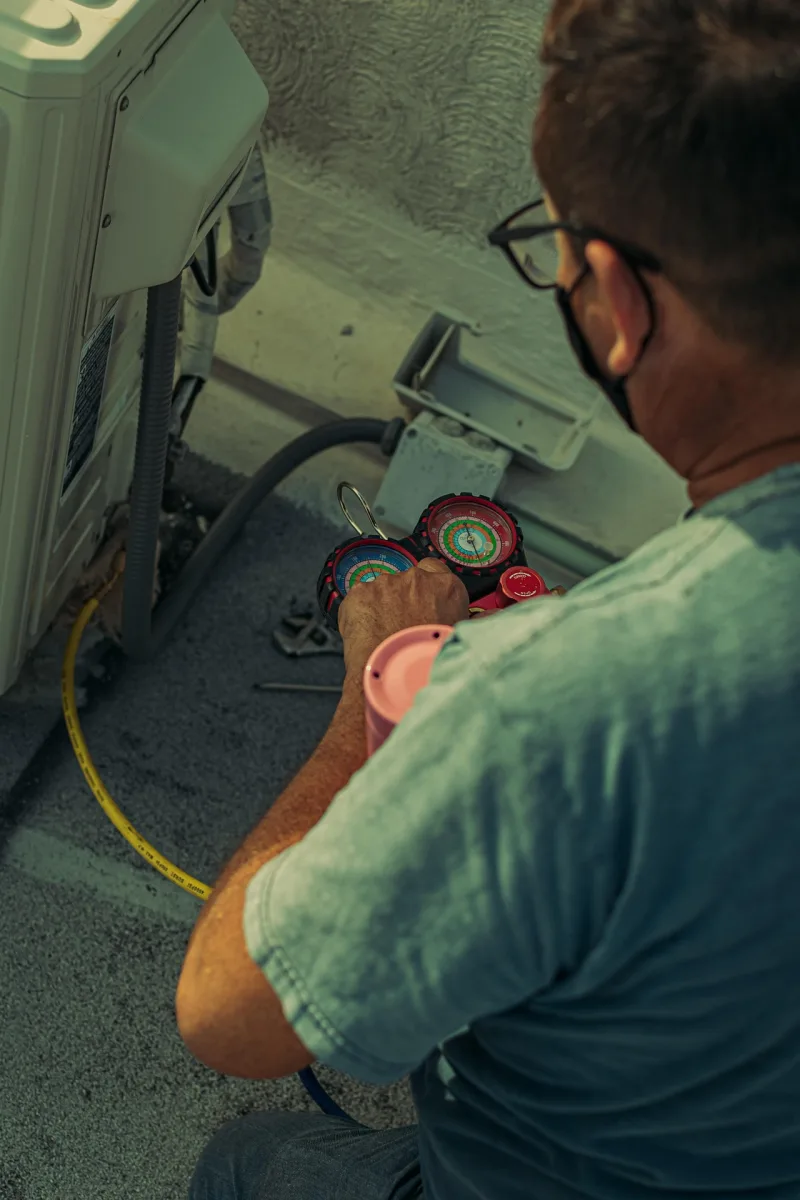
- Refrigerant leak detection, repair and recharge
- Error code diagnosis across all major brands
- Condensate drain blockage clearance
What Are the Most
Common AC Faults?
Most air conditioning faults fall into a handful of categories. Here's what we most commonly find — and fix — on call-out visits.
No Cooling Output
Usually a low refrigerant charge, blocked filter or failed PCB. We diagnose on arrival and carry parts to fix most causes same day.
Water Leaking Inside
Almost always a blocked condensate drain. We clear the blockage, check the drainage fall and test before leaving — typically resolved within an hour.
Error Codes Displayed
Manufacturer-trained engineers interpret fault codes accurately — not just cleared and reset, but the underlying cause identified and resolved.
Unusual Noise
Rattling usually indicates a loose component; grinding or squealing often points to a failing fan bearing. We diagnose and replace on site where parts are available.
Unit Won't Power On
Could be a tripped circuit breaker, blown fuse, failed capacitor or PCB fault. We carry electrical diagnostic equipment and common boards in the van.
Refrigerant Leaks
F-Gas regulations require leaks to be repaired before recharging. We locate the leak, repair it, pressure-test the repair and recharge to the correct specification.

Need a Fast AC Repair
with Fixed Pricing?
We know a broken AC in the middle of summer — or a broken heat pump in January — is an emergency. That's why we prioritise breakdown calls and aim to attend within 24 hours for commercial clients and as quickly as possible for domestic emergencies.
Emergency Cover
Emergency breakdown response — we aim to respond quickly and get your system back up and running
Parts Van
Engineers carry common boards, motors, sensors and refrigerant — more faults fixed first visit
Fixed Call-Out Rate
No surprise bills — our call-out rates and hourly labour rates are agreed before we attend
Full Report
Written fault report and F-Gas documentation provided after every call-out
Looking for a Related Service?
Ventilation Systems
MVHR, heat recovery and extract ventilation for homes and businesses.
Refrigeration & Cold Rooms
Cold room design, commercial refrigeration and emergency breakdown response.
HVAC Design & Consultancy
Load calculations, system specification and project management for HVAC projects.
Electrical & Plumbing
Power supplies, pipework and electrical services supporting HVAC installations.
Compliance & Maintenance
PPM contracts, F-Gas compliance, TM44 surveys and reactive maintenance.
A system that runs but produces no cooling (or very little) is one of the most common call-outs we attend. The cause is almost always one of a small number of things, and we carry the parts and refrigerant to fix most of them on the first visit.
- Low refrigerant charge: the most common cause — a slow leak has depleted the refrigerant over time. Requires leak location, repair and recharge
- Blocked air filter: restricts airflow over the evaporator, causing it to ice up and stop cooling. Often the owner hasn't realised the filter needs cleaning
- Failed indoor fan motor: the unit runs but can't move air across the coil — you'll notice very little airflow from the vents
- Failed PCB (control board): the compressor receives no signal to start. We carry common boards for popular models
- Compressor failure: less common but more serious — we'll advise honestly on repair vs replacement based on system age and refrigerant type
Water dripping from the indoor unit is alarming but in the vast majority of cases the cause is straightforward: the condensate drain is blocked. Left unaddressed, it can cause damage to ceilings, walls and the indoor unit itself.
- The condensate drain removes the water that forms on the cold evaporator coil during normal operation — in summer this can be a litre or more per hour
- Blockages form from algae, dust, mould and dirt that accumulate in the drain tray and pipe over time
- We flush the drain with a biocide solution, check the pipe fall (it must slope to drain correctly) and test the flow before leaving
- If a condensate pump is fitted, we test the pump operation and float switch — failed pumps are a common cause of leaks in installations where gravity drainage isn't possible
- Persistent leaks after drain clearance may indicate a cracked drain tray — we'll inspect and advise
Modern AC units display error codes on the indoor unit panel or via the remote control display. These codes look alarming but are actually very useful diagnostic tools — if you know how to read them.
- Error codes are brand and model specific — a "P8" on a Mitsubishi means something completely different to a "P8" on a Daikin
- We carry manufacturer fault code references and have access to technical service manuals for all major brands
- Simply resetting the error and powering back on often causes the same fault to recur within hours — we always identify and fix the root cause
- Some codes indicate sensor failures, others indicate refrigerant circuit problems, electrical faults or communication errors between indoor and outdoor units
- Photo the error code before calling us — it helps us bring the right parts and prepare before arriving on site
Unusual noises from an AC unit are worth investigating early — what starts as a rattle often becomes a breakdown if the underlying cause isn't addressed. Different noise types point to different components.
- Rattling: usually a loose casing panel, a displaced filter, or debris (leaves, insects) inside the outdoor unit — often resolved quickly on site
- Grinding or squealing: typically a fan bearing on its way out. The fan motor is a wear item and can be replaced on site if we have the correct part
- Clicking or ticking on startup: normal for most units as components expand and contract — only a problem if it continues during operation
- Bubbling or hissing: can indicate a refrigerant leak within the system — worth investigating rather than ignoring
- Loud outdoor unit: compressor vibration can increase as compressor mounts degrade — new anti-vibration feet often resolve this without a full compressor replacement
A unit that won't power on at all is usually an electrical fault rather than a refrigerant or mechanical problem. Most can be diagnosed quickly with the right equipment, and the most common components are stocked in the van.
- First check: is the circuit breaker tripped? Reset it once — if it trips again immediately, there is a fault that must be investigated before resetting again
- Blown fuses on the outdoor unit terminal board are a common cause — we carry an assortment of fuse ratings
- Failed run capacitors prevent the compressor or fan from starting — a very common failure in older units, easy and inexpensive to replace
- PCB failure (control board): more expensive to replace but often the most cost-effective repair on a unit that's otherwise in good condition
- Communication cable faults between indoor and outdoor unit can prevent the system from powering on — we carry cable testers and can splice or replace the communication wiring on site
Refrigerant leaks require careful handling under UK F-Gas Regulations. You cannot simply top up a system that's lost refrigerant — the source of the leak must be found and repaired first.
- We use electronic refrigerant detectors and UV dye injection to locate leaks — even pinhole leaks in pipework or coils
- Common leak locations: flare connections, service valve access ports, the evaporator coil (damaged by cleaning chemicals) and compressor shaft seals
- Once located, we repair the leak, pressure-test the repair to confirm it's holding, then evacuate and recharge to the manufacturer's specification
- F-Gas Regulations require the leak repair to be recorded in the system logbook, along with the quantity and type of refrigerant added
- Systems on older refrigerants (R22, R404A) may be candidates for refrigerant conversion or replacement — we'll advise honestly on the economics